
The Biology of Realism: Why “Good Enough” VR May Not Be Good Enough for the Brain
Aidan Foley - 30th August, 2026
For decades, virtual reality in medicine has been judged by a very different standard from virtual reality in entertainment, and that’s understandable. A video game is expected to transport you somewhere. A clinical application is expected to work.
So medical VR has often been functional rather than beautiful: relatively simple environments, basic animation, flat sound and graphics that communicate what they need to communicate. Nobody particularly cares whether the sunlight falling across a virtual room looks convincing when the purpose of the software is rehabilitation. Or at least, that has been the assumption.
At NEXR, we have started from a very different question: What if the quality of the experience is part of how it works? What if visual realism, spatial sound, fluid movement and almost imperceptible response times aren't cosmetic additions to neurorehabilitation? What if the brain actually cares?
Your brain is remarkably difficult to fool. Consider your own hand. You don't normally need to look at it to know that it belongs to you. Your brain continuously combines information about where your hand is, what it feels, what you intend it to do, what your eyes see it doing and what you hear happening around it. All of those signals agree. That agreement contributes to something so fundamental that we rarely think about it: a sense of ownership. This is my hand. And something closely related: a sense of agency. I made that happen. Neurological injury can profoundly disrupt that conversation between brain and body.
Now imagine trying to reconstruct part of it inside a virtual environment. A person intends to move their hand. A virtual hand moves instead. But it moves slightly too late. Its motion isn't quite natural. The lighting makes it look detached from the world around it. An object it touches produces a generic sound somewhere between the person's ears rather than at the point of contact. Consciously, the person understands perfectly well what the simulation represents. The more interesting question is: Does the brain believe it?
That distinction sits at the heart of our work on what we call Sensory Fidelity.
From distraction to presence
Virtual reality already has an interesting history in medicine, particularly in pain. Some of its early success was explained relatively simply: VR distracted people. Give the brain something sufficiently interesting to concentrate on and fewer attentional resources remain available for pain. But subsequent research has suggested something more interesting. The effectiveness of immersive environments appears to be associated not simply with distraction, but with presence and embodiment - the extent to which someone feels that they are actually inside an environment and that the virtual body they see somehow belongs to them. Our working hypothesis is that this distinction matters enormously for neurorehabilitation.
We aren't trying merely to entertain a patient while rehabilitation happens. We are interested in whether an artificial environment can become sufficiently coherent that the nervous system begins to treat what happens within it as meaningful sensory information. And if that's the objective, “good enough” may cease to be good enough.
The difference between seeing a forest and being in one
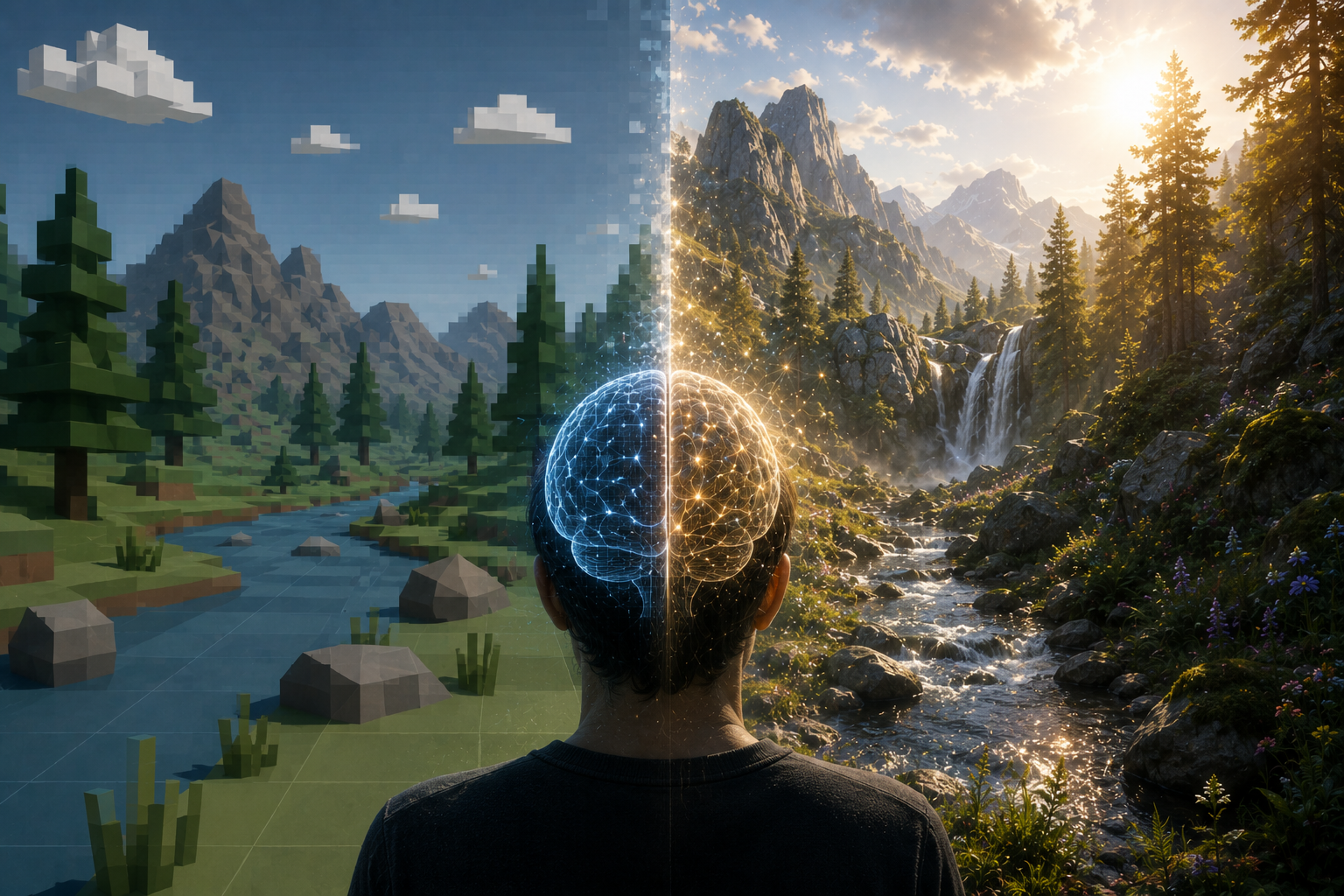
Imagine two virtual forests. In the first, the trees are recognisably trees. There's a blue sky. A stream runs nearby. Birds chirp through conventional stereo headphones. It's perfectly competent medical VR. Now imagine another. Sunlight filters through individual leaves and changes naturally as you move your head. Shadows behave as your brain expects them to. Water reflects its surroundings. When a bird calls from a tree behind your left shoulder, the sound actually appears to originate from that position in three-dimensional space. You reach towards a branch. The visual movement happens virtually instantaneously. Leaves move. You hear them rustle precisely where your virtual hand touches them. And at that same moment, you feel a carefully timed tactile sensation on your real hand. Something fundamentally different has happened. You are no longer merely watching a simulation. Multiple senses are telling the same story at the same time.
That is the territory NEXR is interested in. Fidelity is more than pixels. When people hear “high-fidelity VR”, they understandably think about graphics.
Resolution matters. But our definition is much broader. We think about the problem across several interconnected dimensions: visual realism, smoothness of movement, extremely low latency, spatially accurate sound and, most importantly, agreement between all of them.
A beautiful virtual hand that responds noticeably late is not high fidelity. Neither is a photorealistic environment in which sound behaves unnaturally. Nor is a perfectly rendered movement that bears no relationship to what the person intended to do.
The brain is an extraordinarily sophisticated prediction machine. It constantly compares what it expects to happen with the sensory information it actually receives. The closer those things agree, the more coherent an experience becomes. And that gives us a fascinating possibility.
Sensory fidelity might be something we can dose.
Rather than treating graphical quality, latency or spatial sound as engineering specifications buried in a technical document, we can manipulate them experimentally and measure what happens.
- Does increasing fidelity increase embodiment?
- Does it change measurable brain activity?
- Does it affect engagement?
- Does it alter pain?
- Does there come a point at which the brain's response to a virtual movement becomes measurably different?
Those are scientific questions and we intend to ask them.
The NEXR Sensory Fidelity programme explicitly proposes treating fidelity as an experimental variable - systematically changing rendering quality, audio spatialisation and timing to investigate where sensory prediction begins to give way to therapeutic engagement.
Then there’s sound. Visual fidelity receives enormous attention in VR. Audio receives considerably less and we think that may be a mistake. In the real world, sound doesn't exist “in your headphones”. It exists around you. Close your eyes in a room and someone can click their fingers behind you. Without seeing them, you have a remarkably good idea where that sound came from.
Our auditory system is part of the machinery through which the brain constructs space. So if we're trying to convince the brain that an artificial body exists within an artificial world, sound needs to obey that world too. A virtual hand moves to the right and brushes against something. The visual system sees the contact. The auditory system hears the contact from the same place. The tactile system feels something corresponding to the contact. And, ultimately, all of that can be linked back to the person's original intention to move. The individual components aren't the really interesting part - Their agreement is.
That's why our Sensory Fidelity work brings together the clinical and technical architecture being developed in Dublin with a dedicated creative and ‘NEXR Content’ capability in Stockholm. The creative layer isn't something we're planning to bolt onto the technology once the “important engineering” has been completed. We regard it as part of the engineering.
Timing changes everything
There is another ingredient that makes this considerably harder - Time. Imagine reaching for a glass and watching your hand begin to move a fraction of a second after you decided to move it. It would feel profoundly strange. Our brains are extremely sensitive to these relationships. So NEXR isn't simply interested in producing beautiful virtual experiences. We're interested in producing temporally coherent ones. The scientific framework we're developing therefore treats milliseconds as seriously as pixels.
Our architecture is being designed around very low hardware latency and a tightly synchronised pathway between detected intention and visual, auditory and tactile feedback. The purpose is to investigate whether preserving that temporal relationship strengthens agency, embodiment and ultimately the neuroplastic response. That last part is important.
Investigate.
We're not claiming to have proved that photorealistic VR rewires the injured human brain. We haven't. We're building a platform with which that hypothesis can be tested, and that's precisely what makes this interesting.
There is an extraordinary concentration of expertise in the global games, film and immersive-entertainment industries devoted to making artificial worlds believable.
- Lighting.
- Physics.
- Animation.
- Spatial audio.
- Environmental storytelling.
- Real-time rendering.
- Human perception.
Much of this has historically existed in a different universe from clinical neurorehabilitation. We think those worlds should meet, not because rehabilitation needs to look like a video game - and certainly not because users need prettier graphics - but because entertainment technology has spent decades learning something extremely valuable: how to persuade the human brain to accept an artificial world.
For neurotechnology, that may turn out to matter. A lot.
Realism as a biological variable
Medicine is accustomed to controlling variables. Drug concentration matters. Electrical stimulation amplitude matters. Timing matters. Dose matters. Our proposition is that, in immersive neurorehabilitation, sensory fidelity deserves to be investigated with the same seriousness
- How quickly does the world respond?
- How naturally does it move?
- Does light behave as expected?
- Does sound occupy the correct position in space?
- Do sight, sound and touch agree?
- And, crucially, do all of them agree with the moment the brain intended something to happen?
None of those questions is really about making VR prettier. They're about reducing the gap between what the nervous system predicts and what it experiences. Perhaps the future of medical VR isn't about building increasingly impressive simulations for patients to look at. Perhaps it's about building experiences coherent enough for the brain to participate in, because if we're asking the brain to change, the reality we create for it may matter.